
NEWS | BY KIVNON
Walking time can be reduced by optimizing pickers’ routes through faster picking and the processing of multiple picking orders
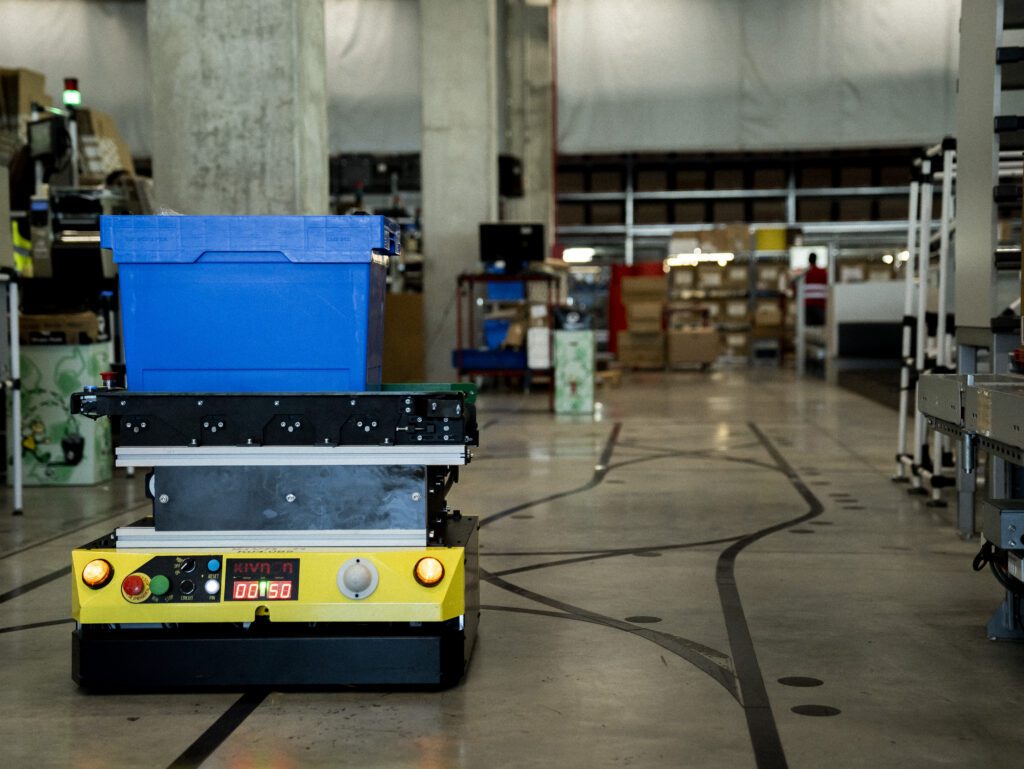
Driven by dramatic increases in e-commerce during the COVID-19 pandemic, there is no sign that automation in warehouses and logistics operations will slow down anytime soon. Compounded by the Great Resignation, there are not enough workers to fulfill all the online orders. Consumer expectations are higher than ever, with same-day delivery now a requirement and a four-hour delivery window preferred.
Reducing the travel time from the loading dock to the production area (A → B) and from the production area (assembly or kitting) back to the loading dock (B → A) for ongoing logistics operations is a quantifiable metric that can be used to justify the costs of automation.
The amount of labor costs associated with walking time is extraordinary, especially for manufacturing and warehouse distribution centers that operate three shifts a day. The main problem is that pickers can spend more than 70% of their picking time simply walking around racks and rooms while searching for items. Reducing walking time by optimizing pickers’ routes can be achieved by increasing picking speed and processing multiple picking orders simultaneously. Automation minimizes the time required to pick items, thereby reducing walking time, and allows items to be collected along the optimal route.
Because the movement of products back and forth between facilities is often highly repetitive, boredom frequently sets in, and employee engagement wanes. It is far better for raw materials to be transported to various work cells. Many warehouse managers have found success by integrating cellular manufacturing work cells into their operations because this brings equipment, people, and processes together in a single location, resulting in higher productivity and throughput.
Simplifying Workflows – Automation to Reduce Walk Time
Work should flow smoothly from one workstation to the next, both within the cell and from one cell to another. Cells should be arranged in a linear order to ensure a logical and continuous flow, and operators should be able to move quickly and easily between machines when necessary. This can be achieved in a forklift-free environment using industrial carts pulled or towed by relatively inexpensive AGVs (automated guided vehicles).
Recently, there has been a trend toward equipping these AGVs with artificial intelligence, machine learning, and other data collection technologies. While these features may seem “cool” and appealing, the reality is that much of the required functionality is mundane and highly repetitive. A quick time study will reveal the amount of non-productive time spent by a manufacturing or warehouse worker performing non-value-added tasks.
Logistics efficiencies, particularly those driven by an e-commerce model, must be measured using two key metrics: zero-defect picking and high product turnover rates. When the correct product is picked accurately and product turnover remains high, logistics are considered most efficient.
Original post from Logistics Brew