
NEWS | BY KIVNON
The challenges facing warehouse and other material-handling operations, and how Automated Guided Vehicle (AGV) technology can help
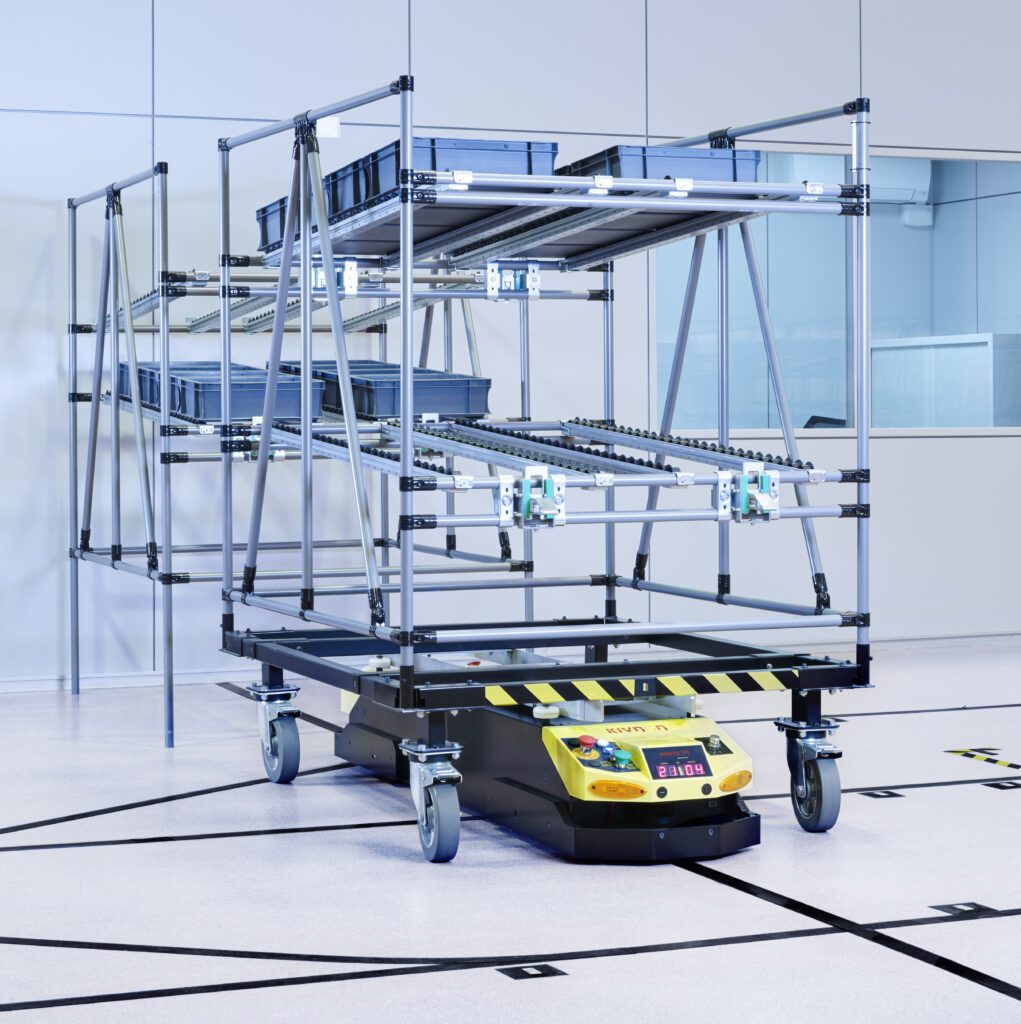
The pandemic both reduced the available workforce and accelerated online sales. Warehouse operations expanded and had to handle increased volume with fewer employees. Before the pandemic, the solution to this problem was to hire more forklift drivers. Now, companies are struggling to find trained forklift operators. These circumstances have led many companies to take a second look at a technology that has been around for a long time: automated guided vehicles (AGVs).
Cost-effective AGV solutions
Before the COVID-19 pandemic, the return on investment (ROI) for automated guided vehicles (AGVs) only made sense for large manufacturing and warehouse operations. In many cases, these larger facilities still needed to operate on two or three shifts to justify the cost of AGV automation. That has changed; reasonably priced AGVs are now available to smaller operations. Ironically, there is now a backlog in the delivery of basic forklifts.
Differences Between AGVs, AGCs, and AMRs
AGVs typically come in two types—forklift-style AGVs and tugger AGVs—and they tend to be larger units. Automated guided carts (AGCs) are smaller but offer the same functionality. Autonomous mobile robots (AMRs) are the newest entrants to the market and are more focused on e-commerce. A key difference between AGVs/AGCs and AMRs is that the former are guided along a fixed path, whereas the latter use radar and other sensing devices—i.e., intelligent navigation—to determine their path. There are also different regulations regarding safety and how they operate.
Catching the automation trend in the automated guided vehicle sector
Automation can only deliver on its promised features, advantages, and benefits if it is cost-effective, available for immediate delivery, and maintains rigorous quality and safety standards. Tried and tested for decades, robotic magnetic-guided AGCs—or magnetic-tape AGCs—have proven effective for the vast majority of market demands. This simple, cost-effective navigation technology is ideal for e-commerce warehouse operations. Companies apply a special magnetic tape to the floor, and the cart follows along the tape.
Magnetic tape is easy to replace, so changes can be made as needed. If the tape is damaged, it’s easy to repair.
The tape can be supplemented with RFID tags that provide simple instructions to the AGV. They can be used in conjunction with new apps such as Flex Tag, which can be accessed on an Android phone.
An example of this technology is Kivnon’s AGVs. This two-vehicle system, which features automatic charging, can operate 24/7 and is a fully automated, turnkey solution that costs around $100,000. Of course, larger units and more complex configurations are also available. Compared to hiring (if possible) and training a forklift operator, this is a fairly low-cost, entry-level automation system.
Catching the automation trend
From a financial standpoint, calculating ROI is essential. Operating on a single shift slows down the return on investment and makes it more difficult to achieve. Conversely, when operating in a high-wage area with two or three shifts running five or more days a week, the investment pays off much sooner.
Original post from: Quality Digest